
Best Radish Seeds
Radish (Raphanus sativus), popularly known as mooli in Hindi, is a widely cultivated root vegetable valued for its crisp texture, refreshing flavor, and nutritional benefits. At DesiKheti, we offer premium-quality radish seeds.
Whether you are a commercial farmer or a home gardener, you can find radish seeds suitable to your needs at DesiKheti. Explore our range of radish seed varieties below, place your order online, and get top-quality seeds delivered directly to your doorstep.
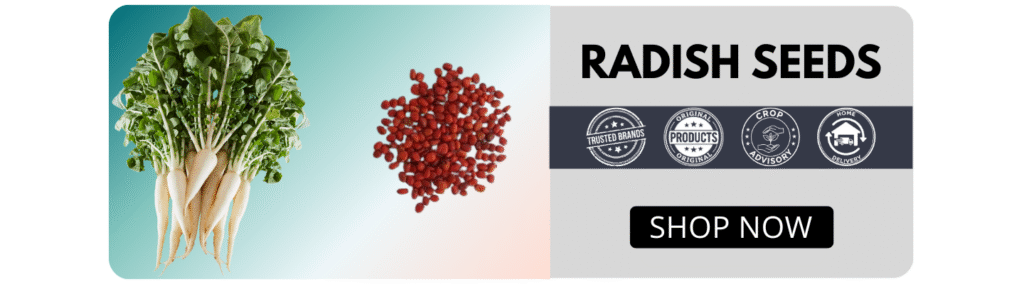
Radish (Raphanus sativus) is a fast-growing root vegetable belonging to the Brassicaceae family, which also includes crops like cabbage, mustard, and broccoli. Believed to have originated in Southeast Asia, the radish is now widely cultivated across India and around the world for its crisp roots, edible leaves, and quick maturity.
Role of Radish in Indian Cuisine
Radish is widely used in Indian kitchens for its crisp texture, refreshing flavor, and nutritional benefits. It is commonly consumed raw in salads, chaats, and raita, adding a crunchy and tangy element to dishes. Cooked radish is used in traditional Indian recipes like parathas, curries, sambar, and soups, enhancing the taste and texture of meals. Radish is also pickled or fermented, providing a flavorful accompaniment that can be stored for months. Beyond its culinary uses, radish leaves are often cooked as a nutritious green vegetable, making the crop versatile and highly valued in Indian households.
Top Radish-Producing States in India
West Bengal, Punjab, Haryana, Madhya Pradesh, Assam, Bihar, Uttar Pradesh, Tamil Nadu, Chhattisgarh, and Odisha are the top radish-producing states in India.
Role of Radish in Global Cuisine
Globally, radish is valued for its crisp texture, mild peppery flavor, and versatility in both raw and cooked forms. In European cuisine, radishes are often served fresh in salads, sandwiches, or as a garnish, while in many Asian countries, they are pickled, fermented, or used in soups and stews. In Japan, daikon radish is a staple ingredient in simmered dishes, sushi accompaniments, and condiments. Radish is also used in juices and health drinks worldwide due to its rich vitamin and mineral content, making it a popular vegetable for both culinary and nutritional purposes.
Non-Culinary Uses of Radish
Beyond the kitchen, radish has several non-culinary applications that make it a valuable crop. Its seeds are used to extract radish seed oil, which is rich in fatty acids and used in cosmetics, skincare, and hair care formulations for its natural conditioning properties. Radish extracts are also utilized in herbal and traditional medicines due to their detoxifying and antioxidant effects, which support liver and digestive health. In addition, radish leaves and roots are used in natural pest control, compost enrichment, and bio-fertilizer production, making it an eco-friendly resource for sustainable farming practices.
Radish Farming
Radish is one of the easiest and fastest-growing root vegetables, making it an excellent choice for both small- and large-scale farmers. Its short cultivation period, adaptability to diverse soils and climates, and high market demand throughout the year make radish farming highly profitable. The crop can be grown multiple times a year, providing farmers with quick returns and a steady income.
Why Radish Farming?
- Short crop duration ready for harvest within 25–60 days.
- High market demand for fresh roots and leafy greens.
- Suitable for intercropping and off-season cultivation.
- Low input cost.
- Potential for local market sales and supply to urban vegetable chains.
However, before starting radish cultivation, it is essential to choose the right radish variety based on local climate, soil conditions, and market demand. Selecting high-quality radish seeds and adopting good agricultural practices can ensure higher yields, better root quality, and increased profitability.
Popular Radish Types in India
1. Pusa Chetki Radish Radish
Pusa Chetki Radish (Raphanus sativus) was developed by the Indian Agricultural Research Institute (IARI), New Delhi. It is a long, white radish variety known for its smooth skin, tender flesh, and mild flavor. This early-maturing type grows best during winter and is ideal for raw consumption, pickling, and cooking.
2. Pusa Desi Radish
Pusa Desi Radish (Raphanus sativus) was developed by the Indian Agricultural Research Institute (IARI), New Delhi. It is a traditional Indian radish variety that produces medium-length, cylindrical roots with crisp white flesh and a slightly pungent taste. Suitable for both irrigated and rainfed conditions, it performs well across different regions.
3. Pusa Himani Radish
Pusa Himani Radish (Raphanus sativus) was developed by the Indian Agricultural Research Institute (IARI), New Delhi. This variety features smooth white skin and crisp, tender flesh. It is well-suited for winter cultivation and adapts easily to diverse soil conditions, making it a preferred choice among farmers.
4. Pusa Reshmi Radish
Pusa Reshmi Radish (Raphanus sativus) was developed by the Indian Agricultural Research Institute (IARI), New Delhi. This early-maturing variety produces long, white, and tender roots with a mild flavour. It performs well under tropical and subtropical conditions and is suitable for early sowing in the North Indian plains. Its smooth texture and crisp flesh make it a popular choice for both fresh consumption and market sales.
5. Hill Queen Radish
Hill Queen Radish (Raphanus sativus) is a variety developed for cultivation in the hilly and cooler regions of India. It produces medium-long, pure white roots with excellent flavour and crispness. This variety thrives under moderate temperatures and is particularly suitable for summer sowing in hill areas. Farmers prefer Hill Queen Radish for its uniform root size, good market appearance, and reliable yield.
Popular Radish Types in the World
- Daikon Radish
Daikon radish (Raphanus sativus var. longipinnatus) originates from East Asia, especially Japan, China, and Korea. It has a long, white root with a mild, slightly sweet flavor and tender texture, and is commonly used in soups, stews, pickles, and salads.
- Red Globe Radish
Red Globe radish (Raphanus sativus) originates from Europe and is a small, round variety with bright red skin and crisp white flesh. It has a sharp, peppery taste and is often used raw in salads, sandwiches, and as a garnish.
- French Breakfast Radish
The French Breakfast radish (Raphanus sativus) originated in France. It is small, elongated, and tapered, with a pink-red tip and white end. Its mild, slightly spicy flavor makes it ideal for raw consumption, and it is often served with bread or in salads.
- Watermelon Radish
Watermelon radish (Raphanus sativus var. longipinnatus) comes from China and has a green exterior with a striking pink to red interior resembling a watermelon. It has a mildly sweet, slightly peppery flavor and is popular in salads and decorative dishes.
- Black Spanish Radish
Black Spanish radish (Raphanus sativus var. niger) originates from Europe and is a large variety with dark skin and a pungent, peppery taste. It is commonly used in traditional European cuisine, either grated, pickled, or cooked.
- Cherry Belle Radish
Cherry Belle radish (Raphanus sativus) originates from North America. It is small, round, and bright red with a crisp, slightly peppery flavor, making it perfect for salads and garnishes.
- Sakurajima Radish
Sakurajima radish (Raphanus sativus var. sakurajima) comes from Japan and is a giant, round variety with a mild flavor. It is commonly used in pickling, soups, and traditional Japanese dishes.
Types of Radish Seeds
Selecting the right radish seeds is a key step in achieving a healthy and profitable crop. Radish varieties differ in shape, color, maturity period, and climate adaptability. Understanding the different types of radish seeds helps farmers choose the most suitable option for their region and farming goals. Broadly, radish seeds can be classified into the following types:
F1 Hybrid Radish Seeds
F1 hybrid radish seeds are produced by cross-breeding parent lines with superior qualities such as uniform root size and faster maturity. These hybrids offer higher yields and consistent quality. They are ideal for commercial cultivation, ensuring uniform harvests and attractive market produce.
Open-Pollinated (OP) Radish Seeds
Open-pollinated radish seeds are naturally pollinated by insects, wind, or other natural agents. Farmers can save these seeds for the next season, as they retain the same characteristics. They are cost-effective and suitable for traditional farming systems and home gardening.
Popular Radish Seed Brands
At DesiKheti, you can buy radish seeds online from top national and international brands. We offer a wide range of hybrid and open-pollinated radish seeds of high quality for both commercial farmers and home gardeners.
Radish seeds from popular companies such as Ashoka Seeds, Enza Zaden, HM Clause, Indo American Seeds, JK Seeds, Kalash, Mahyco, Noble Seeds, Nongwoo Seeds, Pahuja Seeds, Sakata, Sarpan, Unisem, US Agriseeds, and Welcome Seeds are available at DesiKheti.
Explore our collection and buy the best radish seeds online for your radish farming.
Buy Radish Seeds from various brands at DesiKheti:
Ashoka Seeds Radish Seeds | DuFlora Radish Seeds | Enza Zaden Radish Seeds | HM Clause Radish Seeds | Indo American Seeds Radish Seeds | JK Seeds Radish Seeds | Kalash Radish Seeds | Mahyco Radish Seeds | Noble Seeds Radish Seeds | Nongwoo Radish Seeds | Pahuja Seeds Radish Seeds | Sakata Radish Seeds | Sarpan Seeds Radish Seeds | Unisem Radish Seeds | US Agriseeds Radish Seeds | Welcome Seeds Radish Seeds
Popular Radish Seed Varieties
Popular Ashoka Seeds radish varieties available at DesiKheti include Ivory White Radish Seeds.
Popular Enza Zaden radish varieties available at DesiKheti include Branco Radish Seeds.
Popular HM Clause radish varieties available at DesiKheti include Century-05 Radish Seeds.
Popular Indo American Seeds radish varieties available at DesiKheti include Indam Swetha Radish Seeds.
Popular JK Seeds radish varieties available at DesiKheti include JK Green Beauty Radish Palak Patta Seeds.
Popular Kalash radish varieties available at DesiKheti include KKSP-1493 Chetki Radish Seeds.
Popular Mahyco radish varieties available at DesiKheti include Mahy 22 Radish Seeds.
Popular Noble Seeds radish varieties available at DesiKheti include NBH Master Radish Seeds.
Popular Nongwoo Seeds radish varieties available at DesiKheti include KTX 726 Radish Seeds, KTX 999 Radish Seeds, and Sparkle White Radish Seeds.
Popular Pahuja Seeds radish varieties available at DesiKheti include Hill Queen Radish Radish Seeds, Mino Early Radish Seeds, Sneha Radish Seeds, and Barkha Super Radish Seeds.
Popular Sakata radish varieties available at DesiKheti include Shiro-0027 Radish Seeds.
Popular Sarpan radish varieties available at DesiKheti include Sarpan Radish-22.
Popular Unisem radish varieties available at DesiKheti include USM-Amog Radish Seeds.
Popular US Agriseeds radish varieties available at DesiKheti include SW-602 Radish Seeds.
Popular Welcome Seeds radish varieties available at DesiKheti include WS 367 Radish Seeds, WS 273 Radish Seeds, WS 245 Radish Seeds, WS 202 Radish Seeds, WS 174 Radish Seeds, and Welcome Chetki Long Radish Seeds.
Radish Seeds in Farming
Radish seeds are small, round, and reddish-brown in color, obtained from the mature seed pods of the radish plant. They are known for their quick germination and are well-suited to both tropical and temperate climates. Under ideal conditions, radish seeds typically germinate within 3–7 days.
Radish seeds are usually sown directly in the main field rather than in nurseries, as the crop grows quickly and develops deep taproots.
Importance of Choosing Quality Radish Seeds
Seeds are the foundation of successful radish farming, as the overall yield and root quality largely depend on their genetic purity and vigor. Choosing high-quality radish seeds ensures better germination, uniform growth, and healthy root formation.
Using quality seeds helps farmers achieve consistent size, shape, and flavor in their produce. For farmers, investing in premium radish seeds is a practical and profitable decision that leads to better productivity, higher income, and greater efficiency in radish farming.
Why Procure Radish Seeds from DesiKheti
At DesiKheti, we recognize the importance of high-quality and genuine seeds in ensuring a successful radish harvest. That’s why our platform offers a carefully curated selection of radish seeds sourced from reputed national and international brands. Farmers can find a wide range of popular radish varieties suited to different soils, climates, and growing seasons across India.
With DesiKheti, farmers can conveniently browse, compare, and purchase radish seeds online from the comfort of their homes. Our quality seeds, reliable delivery, and commitment to farmer success make DesiKheti a trusted choice for procuring seeds.
Radish Seed Sowing Guide
Before sowing, farmers should check whether the radish seeds are pre-treated with chemicals to prevent soil-borne diseases and pest attacks. Many hybrid and open-pollinated radish seeds available in the market are already treated. If the radish seeds are untreated, they can be treated following expert guidance. Radish seeds are usually sown directly in well-prepared fields rather than in nurseries, as the crop grows quickly and does not require transplanting. Proper soil preparation, adequate spacing, and timely irrigation are key factors for achieving healthy root development and better yields.
Time to Sow Radish Seeds
Radish can be sown throughout the year, depending on the variety and climatic conditions. Temperate types mature within 25 to 50 days, so they are sown closely to make efficient use of space. In contrast, tropical types take longer to mature and produce larger roots; hence, they require wider spacing. Radish can also be grown as an intercrop with other field and vegetable crops such as wheat, grapes, onions, cabbage, cauliflower, and fenugreek (methi).
Method of Sowing Radish Seeds
Radish seeds are usually sown on ridges spaced about 45 cm apart and 22 cm high. A shallow furrow, about 1.25 cm deep, is made along the top of each ridge using the sharpened end of a stick. The seeds, mixed with fine sand or coarse soil for uniform distribution, are sown by hand into these furrows. After sowing, the seeds are lightly covered with soil, and the soil is firmed around them.
Radish Seeds in Different Indian Languages
- Telugu: మూలి విత్తనాలు (Mooli Viththanaalu)
- Hindi: मूली के बीज (Mooli ke Beej)
- Bengali: মুলা বীজ (Mula Beej)
- Gujarati: મૂળીના બીજ (Moolina Beej)
- Malayalam: മൂളി വിത്തുകൾ (Mooli Vithukal)
- Marathi: मूळी बियाणे (Mooli Biyane)
- Odia: ମୁଳା ବିଆ (Mula Bia)
- Punjabi: ਮੂਲੀ ਦੇ ਬੀਜ (Mooli de Beej
- Tamil: முல்லங்கி விதைகள் (Mullangi Vidhai)
- Kannada: ಮೂಳಿ ಬೀಜ (Mooli Beeja)
- Konkani: मूळी बियाणे (Mooli Biyane)
- Assamese: মুলা বীজ (Mula Beej)
- Urdu: مولی کے بیج (Mooli ke Beej)
- Kashmiri: مولی ہُند دانہٕ (Mooli Hund Daaneh)
- Sanskrit: मूलकस्य बीजानि (Moolakasya Beejani)
Popular Radish Seed Research Centres in India
- Indian Institute of Horticultural Research (IIHR), Bengaluru
- ICAR–Indian Institute of Vegetable Research (IIVR), Varanasi
- ICAR Research Complex for NEH Region, Mizoram Centre
- Tamil Nadu Agricultural University (TNAU), Coimbatore
- Kerala Agricultural University (KAU), Vellanikkara
Popular Radish Seed Research Centres in the World
- World Vegetable Center (AVRDC), Taiwan
- Kihara Institute for Biological Research (KIBR), Japan
- Centre for Research in Agricultural Genomics (CRAG), Spain
- National Institute of Horticultural and Herbal Science (NIHHS), South Korea
